Debunking Common Misconceptions About Olympus “Ultra-Slim” Colonoscopes
Does a more compact size mean compromising performance? Join Lenus Vietnam in decoding the PCF – an ultra-slim colonoscope with a distal-end diameter as small as 11.7 mm (compared to 13.2 mm in standard CF scopes) – to discover what’s a “myth” and what’s the “truth.”
Misconception 1: Small-diameter scopes are only for pediatric patients?
Fact: PCF scopes have many applications, including in difficult colon cases, small-built patients, or when colonoscopy with standard scopes has failed.
With a smaller diameter compared to standard scopes, the ultra-slim PCF colonoscope helps reduce pressure on the intestinal wall, thereby improving patient safety and facilitating smoother insertion. Combined with RIT technology, which enables variable stiffness, the scope can easily adapt to complex anatomical characteristics of the colon. These factors are especially meaningful in cases of long colons, multiple angulations, patients with a history of abdominal surgery, or difficult cases where standard scopes have failed.
In addition, specialized scopes such as the PCF-H190T – a therapeutic scope, and the PCF-PH190 – an emergency scope, demonstrate that PCF is not limited to observation but can also be flexibly used in various clinical contexts.

Misconception 2: A smaller scope means it is easier to lose control and harder to handle
Fact: Despite its slim design, PCF maintains controlled stiffness, ensuring stability during manipulation.
The PCF scope is integrated with RIT (Responsive Insertion Technology), which combines three proprietary technologies within the insertion tube: HFT (High Force Transmission), PB (Passive Bending), and Variable Stiffness. These features make scope handling more convenient and the procedure more comfortable for patients. Notably, the variable stiffness function allows adjustment of the scope’s mechanical properties during the procedure via control from the handle. As a result, physicians can actively modify the stiffness of the scope depending on each segment of the colon and the clinical situation.

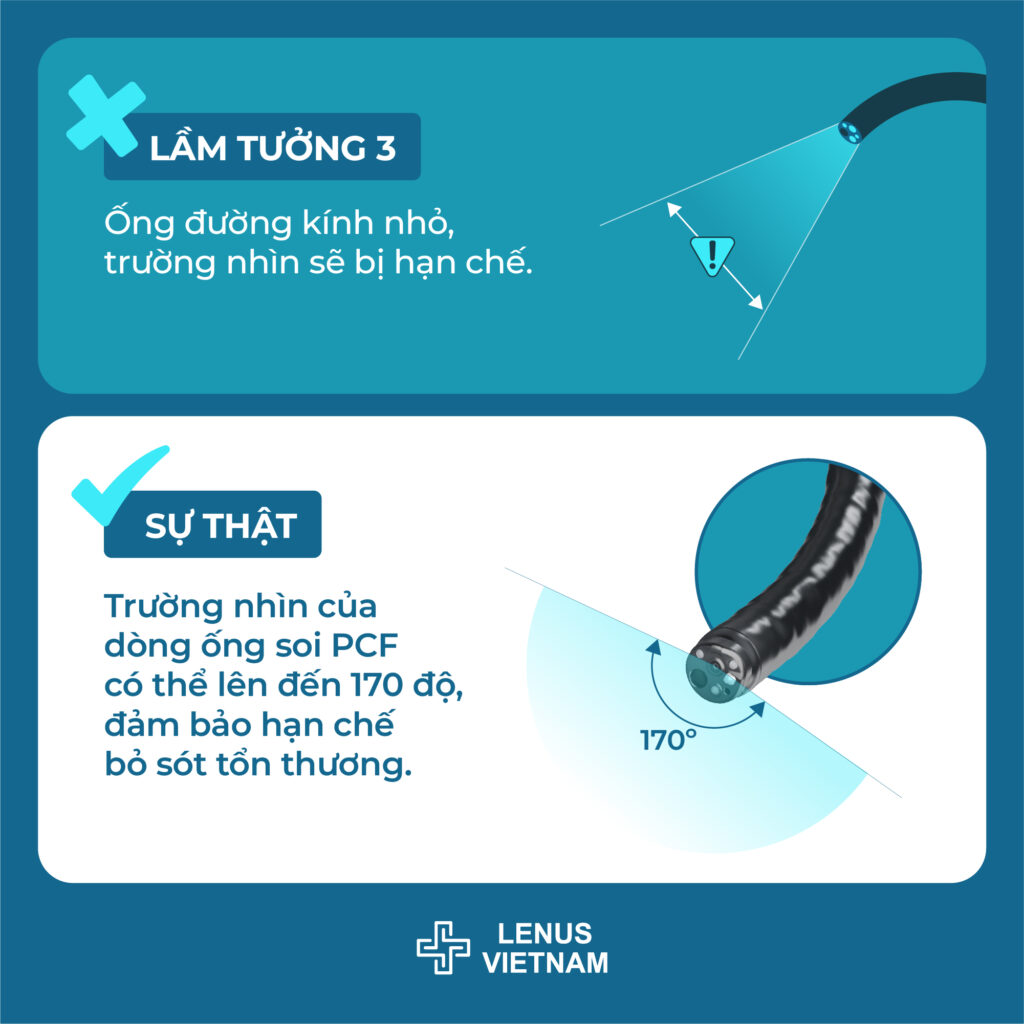
Misconception 3: A smaller diameter results in a limited field of view
Fact: The field of view of PCF scopes can reach up to 170°, helping to minimize missed lesions.
New-generation PCF scopes are designed with advanced optical systems that enable a wide field of view of up to 170°. This expanded view increases mucosal visualization, reduces blind spots, and lowers the risk of missing lesions, especially in areas with multiple folds or complex anatomical angles of the colon.
In clinical practice, the wide viewing angle combined with flexible maneuverability allows physicians to achieve comprehensive observation during both insertion and withdrawal. This contributes to improved detection of small, flat, or hidden lesions and enhances the overall quality of colonoscopy procedures.
Misconception 4: Smaller size means sacrificing working channels
Fact: NOT AT ALL. Smart design ensures full functionality of working channels.
Despite its smaller diameter, the PCF scope is designed with a tip structure that integrates all essential functional channels, ensuring stable interventional capability and compatibility with standard endoscopic instruments. Specifically, at the distal end, PCF still includes all core components such as the instrument channel outlet, light guide, objective lens, air/water nozzle, and auxiliary water channel. These components are redesigned in an optimized layout rather than simply being “miniaturized” from CF scopes.
Thus, the reconfiguration of components at the distal end optimizes space while maintaining light transmission efficiency, image quality, and irrigation performance. As a result, despite its smaller overall size, PCF still ensures a balance between visualization and intervention, allowing physicians to perform procedures accurately, stably, and safely in a wide range of clinical situations.